Industrial agriculture has spent decades telling us that bigger is better — that efficiency, scale, and yield are the only metrics worth tracking. But as soil degrades, rural communities hollow out, and the climate destabilises, a quieter argument is gaining ground: small farms may be doing more for the planet than we give them credit for.
The numbers are easy to dismiss. A 1.5-acre market garden in rural Quebec sounds like a rounding error next to a 10,000-acre monoculture operation in the American midwest. But when Jean-Martin Fortier and his wife Maude-Hélène Desroches turned that small plot into a thriving organic enterprise — grossing over $100,000 a year, feeding more than 200 families, and taking three months off annually — they weren’t just proving a business model. They were demonstrating a different way of thinking about land, food, and livelihood. Fortier documented everything in The Market Gardener, a handbook that has since sold over 200,000 copies worldwide and inspired thousands of small farms across multiple continents.
The question isn’t whether small farms can compete with industrial operations on volume. They can’t, and that’s not the point. The question is what we’re actually optimising for — and whether the current answer is still working.
The soil problem no one wants to talk about
Modern industrial farming treats soil as a medium for delivering inputs, not a living system. Repeated tillage, synthetic fertilisers, and monoculture rotations degrade microbial life, reduce organic matter, and compact the earth until it needs more and more intervention just to produce the same yields.
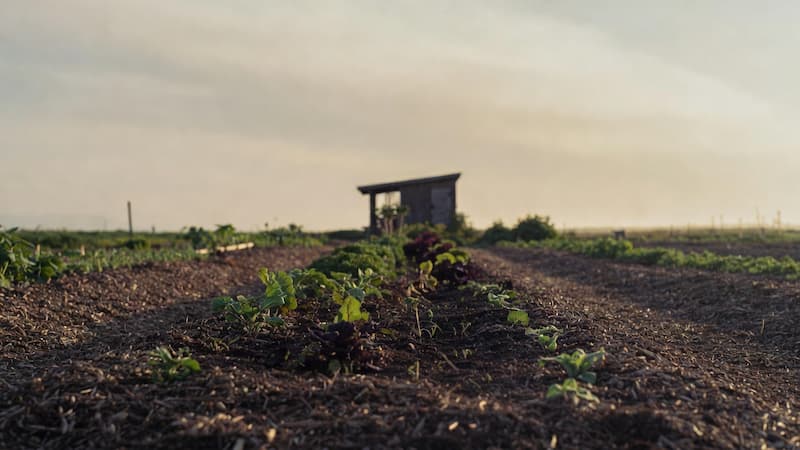
Small-scale regenerative farms work in the opposite direction. Permanent raised beds, minimal tillage, cover crops, and compost-led fertility build soil biology over time rather than eroding it. This isn’t romanticism — it’s measurable. Soil organic matter increases, earthworm populations recover, and water retention improves. A farm managed this way becomes more productive with each passing season, not less.
The UN’s Food and Agriculture Organization estimates that a third of the world’s soils are already degraded. At current rates, the topsoil needed to grow food could be functionally exhausted within a few generations. Small farms that prioritise soil health aren’t just growing vegetables — they’re maintaining the foundation that all agriculture depends on.
The goal was never to grow more. It was to grow better — and to prove that better was enough.
— Jean-Martin Fortier, The Market Gardener
Carbon, biodiversity, and the case for small
Large monoculture operations are significant contributors to greenhouse gas emissions — through tillage, synthetic nitrogen application, fuel use, and the destruction of carbon-storing soil life. Small farms, particularly those using organic and biologically intensive methods, can flip this relationship.
Minimal disturbance practices sequester carbon in the soil rather than releasing it. Diverse plantings support insect populations, birds, and soil organisms that monocultures suppress. Hedgerows, woodland edges, and untilled margins — common on small mixed farms — act as corridors for wildlife. These aren’t side benefits. They’re part of what makes small farms ecologically functional in a way that industrial operations simply aren’t.
Biodiversity loss and climate change are the two largest environmental crises of our time, and both are accelerated by the industrial food system. Small farms are not a complete solution, but they are one of the few parts of agriculture that moves in the right direction on both fronts simultaneously.
Local food, local resilience
The fragility of global supply chains became visible during the pandemic years, when disruptions thousands of miles away emptied shelves and exposed how little slack existed in the system. Communities with strong local food networks — farmers’ markets, CSA schemes, farm-to-restaurant relationships — fared noticeably better.
This is not coincidence. When a farm sells directly to the families it feeds, the feedback loops are short and immediate. Quality matters. Relationships matter. The farm has an incentive to grow what the community actually needs, not just what global commodity markets reward.
Direct marketing also changes the economics. A small farm selling through a CSA captures the full retail value of its produce rather than the fraction available to commodity suppliers. This is part of how Fortier’s operation achieved profit margins that most larger farms cannot match — not through scale, but through relationships and quality. The Market Gardener dedicates considerable attention to this model, framing CSA not just as a sales channel but as a form of shared risk and community investment.
The human dimension
Rural depopulation is one of the quieter crises in countries that have fully industrialised their food systems. When farming requires enormous capital, heavy machinery, and thousands of acres to be viable, it becomes inaccessible to most people. The knowledge base shrinks. Young people leave. Villages decline.
Small farms that can generate a living on a few acres change this calculation. They don’t require generational wealth or corporate financing. They require knowledge, planning, and physical commitment — things that can be taught and shared. Fortier’s Market Gardener Institute has trained thousands of growers globally, demonstrating that the model is replicable across climates and contexts when the right information is available.
A farm that employs seasonal workers, supplies local restaurants, and sells directly to families creates a web of economic relationships that industrial operations, with their consolidated supply chains and absentee ownership, simply cannot replicate.
Growing better, not bigger
The industrial food system isn’t going away. It will continue to produce most of the world’s calories for the foreseeable future. But the argument that it’s the only viable model — or the most resilient one — deserves more scrutiny than it typically receives.
Small farms matter not because they can outproduce industrial agriculture, but because they do things industrial agriculture cannot: build soil, sequester carbon, support biodiversity, strengthen communities, and offer a path to meaningful rural work. They are part of an ecosystem of solutions that a food system under pressure badly needs.
Fortier’s central argument in The Market Gardener is simple: a small, well-designed farm can support a good life while doing genuine good for the land it sits on. That idea — unfashionable for decades — is starting to look like exactly the kind of thinking the next generation of farmers needs.
Browse the full Sustainability archive for more.