Somewhere between finishing work and falling asleep, most people lose two or three hours they can barely account for. Not to rest, not to connection, not to anything that feels particularly chosen — just to the scroll, the autoplay, the blue glow that keeps the nervous system running long past the moment it asked to stop.
There’s a word for what we’ve done to our evenings: colonised. The same productivity logic that governs the workday now follows us into the hours after dinner. And if we’re not being productive, we’re being stimulated — fed a continuous stream of breaking news, algorithmic recommendations, and social comparison that the body registers as arousal, not rest. The result is people who are technically off the clock but physiologically still at their desks, wondering why they can’t sleep and why everything feels vaguely exhausting.
Slow evenings are the answer. Not a programme, not a wellness challenge — just a reclaiming of something the body already knows how to do, if we stop fighting it.
Where the idea comes from
The slow movement didn’t start with evenings. It started with a bowl of pasta outside a McDonald’s in Rome. In 1986, Carlo Petrini handed penne to protesters gathered at the opening of Italy’s first fast food restaurant near the Spanish Steps. What began as a defence of regional food became, over the following two decades, a broad cultural argument: that faster is not the same as better, and that the race to speed up every domain of human life was costing us something we couldn’t easily name.
By 2004, Carl Honoré had given the argument its most influential shape. His book In Praise of Slowness described the slow philosophy not as a rejection of modernity but as a correction to it — “doing everything at the right speed. Savouring the hours and minutes rather than just counting them.” The book opened up a new vocabulary: slow cities, slow education, slow medicine, slow parenting. Each of these was, at its core, an argument for giving things the time they actually need.
The slow movement found its way into evenings through a slightly different door. During the pandemic, with forced stillness giving people an unexpected glimpse of what unhurried time felt like, interest in slow living quadrupled almost overnight. Google reported a four-fold increase in YouTube videos with “slow living” in the title in 2020 compared to 2019. What many people discovered wasn’t that they needed more time — it was that they needed different time. Quieter time. Time that didn’t demand anything from them.
What the body already knows
Long before the slow movement had a name, the human body had a nightly protocol. As daylight fades, the pineal gland begins releasing melatonin — the hormone that signals the nervous system to wind down. Cortisol, the stress hormone that peaks in the morning to get us moving, starts to fall. Core temperature drops. Breathing slows. The body is, quite literally, downshifting.
This process has a name — the circadian rhythm — and it is exquisitely sensitive to light. Specifically, to the short-wavelength blue light that happens to be the same spectrum emitted by every screen we own. Research published in multiple peer-reviewed journals confirms what most people intuitively suspect: exposure to blue light in the evening suppresses melatonin, delays sleep onset, and disrupts the circadian timing that governs not just sleep but digestion, immune function, and mood.
The consequence of spending the evening on a phone isn’t just less sleep. It’s a body that never quite gets the signal that the day is done.
The great benefit of slowing down is reclaiming the time and tranquility to make meaningful connections — with people, with culture, with work, with nature, with our own bodies and minds.
— Carl Honoré, In Praise of Slowness
The cultural wisdom we named but didn’t keep
Every culture that has ever lived through a long, dark winter developed some version of the slow evening. They just called it different things.
The Danes called it hygge. The word appears in written Danish from the early 1800s but traces back further, to an Old Norse root relating to fire — the warmth and light that offered protection from the dangers outside. Meik Wiking, CEO of the Happiness Research Institute in Copenhagen and author of The Little Book of Hygge, identifies the core ingredients as togetherness, relaxation, presence, and comfort. Not luxury. Not productivity. Not self-improvement. Just the quiet fact of being somewhere safe with people you trust, with something warm in your hands.
The Swedish call a similar practice fika — a coffee break that is really a declaration that the day has room in it for pause. The Japanese concept of ma describes the empty space that gives other things meaning: the silence between notes, the gap between words, the unhurried hour between dinner and sleep that lets the day breathe before it closes.
What these traditions share is not a technique but an understanding: that the transition from wakefulness to rest cannot be rushed, and that the quality of the evening shapes the quality of everything that follows.
Why modern life is at war with all of this
The problem is structural. Doomscrolling — the compulsive consumption of distressing news and content — was named one of Oxford’s words of the year in 2020, and the phenomenon it describes predates the word by years. Harvard Medical School researchers note that doomscrolling is linked to headaches, muscle tension, difficulty sleeping, and elevated blood pressure. A 2023 research review of three studies covering around 1,200 adults found it consistently associated with lower life satisfaction and worse mental wellbeing.
But it’s not just bad news we’re consuming. It’s the architecture of the platforms themselves. Algorithms are designed to hold attention, not to release it. Every platform is optimised to ensure that putting the phone down feels harder than picking it up. The result is what Johann Hari, in Stolen Focus, calls a collective attention crisis — not a personal failure of willpower but a systematic dismantling of our capacity to be anywhere fully, including in our own evenings.
The tragedy is not just lost sleep. It’s the quiet hours that could have been something — a meal tasted rather than eaten next to a phone, a conversation that ran somewhere unexpected, a book that asked something of you, a view from a window that reminded you of the world’s actual scale.
What a slow evening actually looks like
Here is what a slow evening is not: a twelve-step programme. One of the more honest accounts of the slow living movement’s early failures is the recognition that trying to be intentional about everything — morning routine, mindful commute, screen-free dinner, journaling, meditation, skincare ritual, phone-off-an-hour-before-bed — can produce a kind of exhaustion that makes Netflix feel like the most radical act of self-care available.
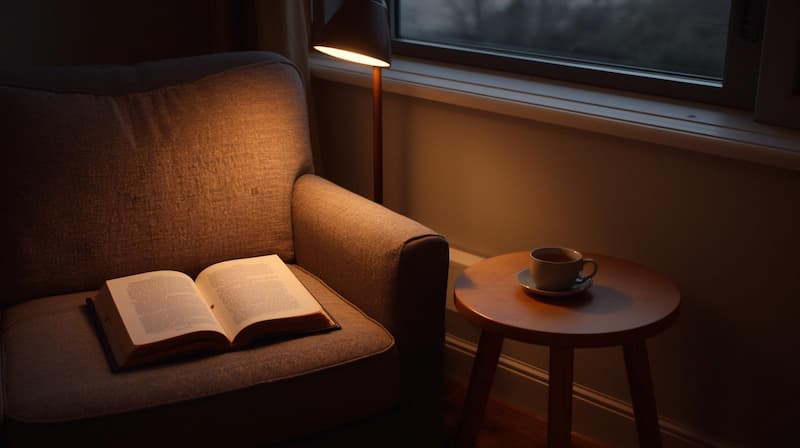
A slow evening is smaller than that. It is a transition, not a transformation. The key move is a single shift in context: something that tells the body the doing is over and the being can begin. For some people that’s changing clothes. For others it’s the act of lighting a candle — a ritual small enough to be frictionless but specific enough to carry meaning. For others still it’s a walk without headphones, a cup of tea made slowly, or the opening pages of a novel read in actual paper.
Oliver Burkeman, in Four Thousand Weeks, makes the deeper argument: the problem with how we spend our evenings is the same problem with how we spend our lives — we treat rest as something to be earned, optimised, and scheduled, rather than as the ground condition of a human life. A slow evening is, in this reading, not a wellness practice. It is a philosophical stance. A refusal to treat every hour as a resource to be deployed.
We treat rest as something to be earned rather than as the ground condition of a human life.
— Oliver Burkeman, Four Thousand Weeks
Jenny Odell pushes this further in How to Do Nothing. She argues that in an attention economy where every idle moment is treated as an opportunity to be monetised or optimised, the act of simply being present — in a garden, in a conversation, at a window — becomes genuinely subversive. Slow evenings are not laziness. They are a form of resistance.
Books for the hours after dinner
In Praise of Slowness — Carl Honoré (2004)
Honoré was rushing through his son's bedtime story — eyeing a book that promised one-minute versions of classic tales — when he caught himself and understood the problem wasn't his schedule. It was his relationship with time. That moment became the seed of the book that introduced slow living to a global audience.
What makes it essential reading is that Honoré doesn't romanticise slowness. He doesn't argue for doing everything at a crawl. He argues for doing everything at the right speed — and for recognising that we've systematically miscalibrated what "right" means. The chapter on leisure is particularly sharp: we've turned rest into another form of performance, and we're all suffering for it.
The Little Book of Hygge — Meik Wiking (2016)
Wiking runs the Happiness Research Institute in Copenhagen and has spent his career asking why Denmark consistently ranks among the world's happiest countries. His answer, in this book, is surprisingly non-materialist: it's not the welfare state alone, not the cycling infrastructure, not the work-life balance policies — it's the culture of hygge, the deliberate practice of creating comfort and presence in everyday life.
For slow evenings specifically, the book is a practical guide disguised as a cultural study. Wiking breaks down hygge into its components — lighting, food, togetherness, presence — and shows how each one is essentially an argument against the ambient busyness that colonises the modern evening. You don't need Denmark's winters. You need candles and the willingness to put your phone in another room.
Stolen Focus — Johann Hari (2022)
Hari spent three years interviewing scientists, psychologists, and technologists to understand why we can't pay attention anymore. His conclusion is uncomfortable: it's not a personal failure. The environment we live in — algorithmically optimised, notification-saturated, attention-extracting — is systematically degrading our capacity for deep focus and genuine rest.
The relevance to slow evenings is direct. Hari shows that the same mechanisms driving doomscrolling and compulsive checking — the variable reward loop, the social comparison engine, the artificial urgency — are active precisely in the evening hours when we're most depleted and least equipped to resist them. Understanding the system is the first step to opting out of it.
Four Thousand Weeks — Oliver Burkeman (2021)
The title refers to the approximate number of weeks in an eighty-year life. Burkeman uses this fact not to motivate productivity — as most time management books do — but to make the opposite argument: that we have so little time that spending it trying to optimise every hour is precisely the wrong response. Finitude is the invitation to be fully present in the hours we actually have.
This is the book to read if slow evenings feel like something you need to justify. Burkeman dismantles the Protestant-efficiency logic that makes rest feel like failure, and makes a philosophically rigorous case for the kind of unhurried evening that doesn't produce anything except the experience of having lived it.
How to Do Nothing — Jenny Odell (2019)
Odell is an artist and Stanford professor who became interested in what it means to refuse — not to drop out of society, but to resist the attention economy's demand that every moment be productive, shareable, or monetisable. Her argument is ecological as much as political: that the capacity for sustained attention, for genuine rest, for presence in a place, is something that needs protecting the way a habitat needs protecting.
The book is strange and slow and somewhat difficult, which feels appropriate. Reading it in the evening — away from a screen, without hurrying — is itself a kind of practice. Odell doesn't tell you what to do with your quiet hours. She makes a case for why having them matters.
The evening as the whole day’s argument
There is a way of reading the quality of a life through its evenings. Not through the grand accomplishments, the career milestones, the bucket list items — but through the ordinary hours between dinner and sleep, which come around every single day and ask, in their quiet way, what kind of person you’re choosing to be.
Slow evenings are not a solution to structural problems. Overwork, economic precarity, caregiving — these create genuine constraints that no amount of candlelight can fix. But for those with even a little discretionary time in the evening, the question of how to spend it is more consequential than it appears. A slow evening is not a luxury. It is a practice of attention, accumulated over years, that changes what you notice and what you value.
Start with one thing. Put the phone in another room. Make something warm to drink. Open the window or the book. Let the evening be what it was designed to be: the long, gradual descent toward rest, and the quiet return to yourself.
Browse the full Simple Living archive for more.