Most books about simple living tell you what to do: buy less, own less, want less. They come with frameworks and systems and a quiet air of moral superiority. But some of the most powerful lessons about what enough actually feels like don't come from non-fiction at all — they come from stories.
Fiction has a way of getting past your defences. You’re not being taught. You’re just watching a life unfold, page after page, and somewhere along the way something shifts. You put the book down and you see your own kitchen differently. Your own coat. Your own Saturday morning.
The three novels below share almost nothing in terms of setting or era. But each one carries the same quiet argument: that a life lived close to its essentials — without much money, without much stuff, but with full attention — is not a lesser life. It might be the only kind worth living.
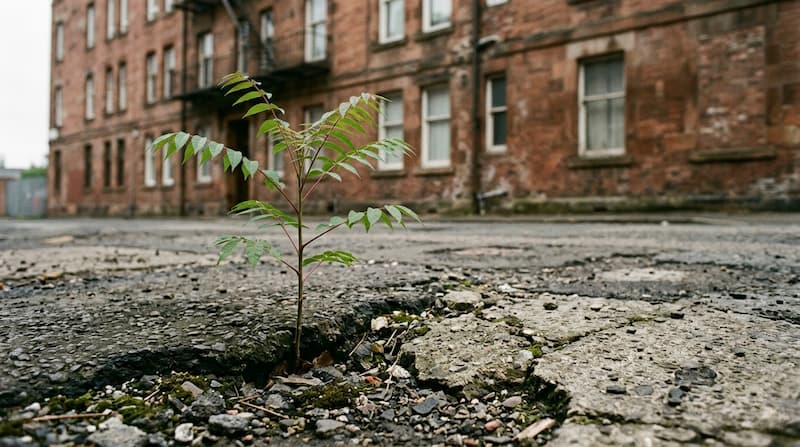
There's a tree that grows in Brooklyn. Some people call it the tree of heaven. No matter where its seed falls, it makes a tree which struggles to reach the sky.
— Betty Smith, A Tree Grows in Brooklyn
Why fiction works when self-help doesn’t
There’s a reason we remember stories better than advice. A self-help book can tell you that material things don’t bring happiness. A novel can make you feel, viscerally, what it is to be Francie Nolan — a girl who becomes intoxicated by the sight of flowers because flowers are free. The lesson arrives through the body, not the brain. It sticks.
These are not books that set out to teach simple living. They are books that simply depict it — honestly, without sentimentality, without pretending poverty is romantic. And that honesty is precisely why they work.
A Tree Grows in Brooklyn — Betty Smith (1943)
Francie Nolan grows up in a tenement in Williamsburg, Brooklyn in the early 1900s. Her father drinks. Her mother scrubs floors. They are one bad week away from hunger most of the time. And yet the novel is not about deprivation — it is about attention. Francie notices everything: the feel of a library book, the smell of a Saturday market, the specific quality of winter light falling through an iron fire escape. She collects the world because the world is what she has.
What makes this novel feel radical today is how directly it contradicts the logic of modern consumption. Francie does not wait until she has more to begin living. She finds the extraordinary inside the ordinary with a discipline that most people spend their whole lives trying to learn from podcasts and minimalism manifestos. Betty Smith based the story largely on her own childhood, and that autobiographical weight gives every scene a groundedness you can feel.
Readers consistently report that this book changes something in them — not with instruction, but with immersion. You spend time inside a life that has almost nothing by contemporary standards and you come away wondering what, exactly, you've been accumulating and why.
My Ántonia — Willa Cather (1918)
Ántonia Shimerda arrives in Nebraska from Bohemia as a child, barely speaking English, her family's survival dependent on land that is vast and indifferent and beautiful. Cather's prose describes the prairie with the kind of attention most writers reserve for people. The grass, the sky, the smell of the earth in different seasons — all of it is rendered with a precision that reads almost like nature writing.
The connection to land in this novel is not metaphorical. It is literal and physical. Ántonia works the soil with her hands for most of her life, and the novel treats this work with complete dignity. There is no irony here, no distance. By the end you understand that her life, lived so close to its material foundations, is not a life of less — it is a life of more, in the only direction that matters.
For anyone interested in the relationship between simple living and the natural world, this is an essential pairing with any reading list on sustainability or conscious living.
Little Women — Louisa May Alcott (1868)
The March sisters live without their father during the Civil War, with little money and a household that runs almost entirely on ingenuity, cooperation, and the willingness to find meaning in small things. Alcott doesn't romanticise their situation — she shows the friction of it, the jealousy and the sacrifice and the days when it's genuinely hard. But she also shows, with quiet persistence, a family that has built a rich interior life inside modest external circumstances.
What often gets missed in discussions of this novel is how much of it is about the relationship between creative work and a simple life. Jo writes. Beth plays piano. Amy draws. These are not hobbies — they are the substance of who these women are, cultivated inside a life that has very little room for accumulation. The novel argues, without ever stating it directly, that a life organised around making rather than having is a different kind of life entirely.
Read alongside A Tree Grows in Brooklyn, Little Women offers a different angle on the same essential question: what do you actually need in order to live fully?
What these books share
None of these novels set out to argue for minimalism. None of them use the language of intentional living or conscious consumption. They predate those concepts by decades. And perhaps that is exactly why they work so well as a counterweight to modern self-help: they are not trying to convince you of anything.
They are simply showing you people who live close to the essential — close to land, close to family, close to the small daily things that carry meaning — and trusting you to draw your own conclusions. That trust in the reader is itself a kind of lesson.
If you find yourself exhausted by advice about living better, try spending time with Francie Nolan instead. Let her walk you through the Saturday market. Let her show you what enough looks like when it isn’t dressed up as a philosophy.
Browse the full Simple Living archive for more.